
Hammer Horror Deep Dark Thoughts
This British Film Studio was responsible for my of the best horror films of the ’50s, 60’s and early 70’s. I remember spending hour upon hour watching many of their classic films Saturday afternoon on “Creature Double Feature.” Their success went well beyond remaking many of the Universal Monster Movie (in fact their Dracula series of films starring Christopher Lee and Peter Crushing far exceeded their American counterpart). Below in this article, you can get details of Hammer horror movies list
In the ’50s, horror was dying a slow painful death as my studios were now putting the money they used to use making horror film onto the sci-fi arena. What a great way to exploit the “Red Scare”. Millions of paranoid American not only feared a Soviet attack but an invasion from outer space as they packed the theaters to see such great films as “Invasion of the Body Snatchers” or “The Thing from another World“. Although Hammer did dip into the Sci-fi genre with “The Quatermass Series”, their main focus was to make horror films and can directly be credited with keeping the genre alive and kicking during this time.
Hammer, along with AIP and Amicus, can be cited for spearheading the new Goth cinema. This was a new era for horror. America was beginning to lose footing in the genre as their European counterparts pushed the envelope throughout the early and mid-’60s. It was only at the end of the ’60s with “Night of the Living Dead” and “Rosemary’s Baby” that the American efforts began to re-establish its’ presence in the genre.
So “God save the Queen” and Hammer Studio for their outstanding dedication to the genre we all love. Hammer last feature film release in the theater was “To the Devil… A Daughter” in 1976. Throughout the 80’s I hear they did numerous things on British TV such as “Hammer House of Horror” and “Hammer House of Mystery”. One encouraging thing that I have read is that Hammer still owes the right to all its movie. I also heard that Hammer may go back into production and I only hope this true.
On this page, I will give reviews of my “favorite” Hammer Films as I begin to revisit them. If anyone has any suggestions on where to turn next for a viewing, please email me. Enjoy the fabulous World of Hammer.
The Curse of Frankenstein Story
 A raving madman, hours away from being executed, calls for a Priest. Is he hoping to clear his conscious, crying for spiritual cleansing or still loudly proclaiming his innocence? Fearing for his life, the Priest reluctantly agrees to listen as Baron Victor Von Frankenstein (Peter Cushing) begins to weave this tale of terror.
Many years before, a young man has just inherited his family fortune and is searching for a private tutor to help continue his studies while he assumes responsibility for the family’s affairs. In steps his new teacher Paul Kempe (Robert Urquhart), who quickly becomes his companion and friend.
As the young Baron quickly grows into manhood, his ambitious begin spiraling out of control as he searches to unravel the secrets of life. After years of experimenting, success finally comes when they are able to reanimate a dead puppy. Overflowing with happiness, Paul urges Victor to publish his findings for all the world to see, but the Baron doesn’t plan to stop there and Paul reluctantly agrees to join him on his dark journey.
When word comes that criminal has been hanged in the gallows, Frankenstein realizes that he now has the building blocks for his creature, but agonizes over his creations having the “knowledge of a lifetime”. It is this thirst that leads the good doctor to murder one of his colleagues, Dr. Bernstein (Paul Hardtmuth) for his brain which is later damaged in a struggle.
While Victor continues his experiments in secret, Paul tries unsuccessfully to convince Victor’s finance, Elizabeth (Hazel Court) to leave the castle. Later a stray bolt of lighting accidentally bring the creature to life to wreak havoc on all who gets into its’ way, but the burning question of this film is “who is the real monster”?
After several successful years of making sci-fi films like: “The Quatermass Xperiment”, “X: The Unknown”, and “Quatermass 2”, Hammer had foreseen the downward turn the genre way heading in and decided that horror was the next logical step.
“Curse of Frankenstein” had originally been envisioned as a vehicle for Karloff, but Hammer quickly shied away when Universal threaten to sue if their interpretation in any way, shape, or form mimicked their own. Director Terence Fisher, whose vision gave birth to Gothic Horror, was brought in to helm Hammer’s most important film to date. He was later joined by Christopher Lee and Peter Cushing who were working together for the first time.
This partnership, which would play out for over 15 years, forever changing the horror landscape as we knew it. Furthermore, Cushing’s interpretation of Frankenstein was a far cry from that of Clive Colin back in 1931, here we knew who truly was the monster; Dr. Frankenstein himself.
On the other hand, Lee’s Monster/Creature was purely animalistic in nature and form, a blank slate of pure uncontrollable violence which helped to deliver a much darker version of Mary Shelley’s story. Finally, “Curse” marked the first time that the Frankenstein legend had been brought to the silver screen in blood rich color and Hammer didn’t skimp on the gore. The audience responded by making it a box-office smash around the world grossing back well over 70 times its production cost.
The Mummy 1959 Story
 Egypt 1895. As British archeological team begins to enter the lost tomb of Princess Ananka, high priestess of Carnic, when they receive a warning for a local (George Pastell), “He who robs the graves of Egypt dies“. Brushing it off as mere superstition, they enter anyway. While inside, Stephen Banning (Felix Alymer) reads from the “Scroll of Life” bringing to life the mummy, Kharis. Now frozen in a state of delirium, Banning is sent home and his son, John (Peter Cushing) is left behind to seal the tomb.
Three years later while recovering in a mental institute, the elder Banning awakens from his nightmares and warns that the mummy will be coming for revenge. Passing it off as delusions of a sick man, John neglects his father’s warnings. He finally realizes the truth when he witnesses the mummy murdering one of his father assistants, Joseph Whemple (Raymond Huntley) and now knows that he is next.
While studying Ananka, John discovers that Kharis (Christopher Lee) had been her servant and lover. He had been buried alive when he was found trying to bring the Princess back from the dead. At the same time, he realizes that his young wife Isobel (Yvonne Furneaux), is the living incarnate of Princess Ananka. Could this be the weakness that John needs to defeat the indestructible MUMMY???
When Hammer acquired the rights to remake the classic monster movies from Universal, they quickly jumped on the Dracula and Frankenstein franchises. In 1959, they decided that “The Mummy” would be the next film to go before the camera and handed the reins over to their masterful director Terrance Fisher. This film succeeds on all levels and is rich in color, atmosphere, music, and story. Hammer was able to take the best parts from the original film and mixed in the mythos of Kharis from the sequels to make a highly entertaining film. Both Lee and Crushing are excellent as always, and Hammer makes “The Mummy” a real winner!
Brides of Dracula Story
 As the movie begins, we see a coach racing wildly across the countryside towards the setting sun. Onboard, Marianne (Yvonne Monlaur) is preparing to start her new job at a prestigious girls school, when her coach unexpectedly stops in a tiny village. While waiting to be off again, Marianne hears her coach racing away in the distance. Now abandoned, a jittery innkeeper explains he has no rooms available and quickly scampers away trying to secure her an alternative form of transport, but he is too late.
Outside we hear a coach pulls up. Who could it be??? It is Baroness Meinster (Martita Hunt) whom upon hearing of the women’s misfortunate graciously invites her up to the castle for the night.
While staying at the castle, Marianne sees a man attempting to jump off a balcony. She quickly races down to stop him only to find out it is the Baroness’ son (David Peel). As Marianne approaches him, she notices that he is shackled at the ankle. The Baron explains that his mother has told everyone that he is dead, hoping to keep him locked up so she can control his inheritance. He is finally able to convince Marianne to help free him. Later when confronted by a hysterical Baroness, Marianne flees the castle.
She is found passed out on the roadside by Dr. Van Helsing (Peter Cushing) who returns her to the village. It seems the good Doctor has been called upon to come and investigate a strange death. Upon his arrival, he notices that the forces of evil are loose and the hunt begins.
The end sequence marked a terrific conclusion in this ultimate battle between good and evil. This the second film in Hammer’s Dracula series even though it has nothing to do with Dracula. Originally slated as a follow-up project to Horror of Dracula, Christopher Lee declined the role because of fears of being typecast. He would later reprise his mainstay role eight years later in Dracula-Prince of Darkness. Back for this film are director Terence Fisher, screenwriter, and Peter Cushing as Dr. Van Helsing. One, if not, the best vampire film from Hammer.
The Curse of the Werewolf Story
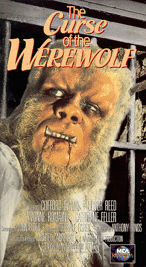 Eighteenth-century Spain, the film opens as the Marques (Anthony Dawson) is in the midst of celebrating his wedding. During, the festivities, a knock at the door brings an interruption from hungry beggar (Richard Wordsworth) looking for a little substance. After toiling with his new pet for a few minutes, the Marquis quickly grows irritates and throw derelict thrown into the dungeons, where he remains forgotten by all but the jailer and his mute daughter (Yvonne Romain) for many years.
As the days go by, a decrepit Marques hoping to again sow his wild oats tries having his way with the unsuspecting mute servant girl. When she rejects the Masters? advances, he has her thrown into the dungeon, where the beggar, who has become a rabid animal, rapes her. Once she is released, she quickly creeps up and viciously does away with Marques. Fleeing for her life, she eludes capture by the authority by living like a wild animal in the woods, until one day when she is taking in by Don Alfredo (Clifford Evans).
As the girl recovers in the warmth of Alfredo? home, his servant Teresa (Hira Talfrey) realizes she is with the child but is fearful that child will be born on Christmas Day. Just as the Christmas bells chime out; the howl of a wolf can be heard followed by that of crying of a newborn babe. Unfortunately for Leon, his mother dies after giving birth.
As the years go by, young Leon’s birthright begins to catch up with him when as a young child he is haunted by strange nightmares of beginning a wolf and this coupled along with the death of a flock of sheep sends Don Alfredo to the local parish for guidance. It is there that his worse fears are confirmed; Leon is a werewolf. The Father suggests bathing the child with love and care in hopes of suppressing the spirit of the wolf that now possesses him.
For many years, the love of his adopted family (Alfredo and Teresa) helps to keep at bay the beast, but now the time has come for Leon (Oliver Reed) to go out in the real world. When he takes up trade as a winemaker, he enters into a forbidden love affair with his boss?s daughter Cristina (Catherine Feller). Hoping to steal away with his love, Leon is persuaded to spend one last night carousing at the local bordello, but as the full moon rises high in the night sky, he has transformed once again into a murderous werewolf. As the torch-bearing villagers search for the monster, only love can save Leon.
After conquering Frankenstein, Dracula, and the Mummy, the next logical step for Hammer alumni Terence Fisher was the Werewolf. The story for the film came from Guy Endore?s 1933 novel? The Werewolf of Paris? and was originally owned by Universal. In the early summer of 1960, Universal subcontracted those rights to Hammer who quickly moved the film into production.
The film was able to take advantage of the set that were abandoned from Hammer’s feature? The Inquisitor? which had been canceled earlier that year, because of fears of condemnation by the Catholic Church. Roy Ashton’s outstanding makeup effects couple with Oliver Reed’s portrayal of the cursed Leon helped to bring to life first rate werewolf films. “The Curse of the Werewolf” is easily one of the greatest lycanthrope films ever to grace the silver screen, done as only Hammer could do it.
Dracula: Prince of Darkness Story
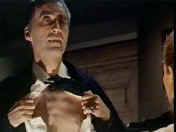 The story begins as two couples while traveling in eastern Europe decide to visit Carlstad despite dire warnings of the locals. Abandoned by the coachman who is terrified of the approaching night. They seek shelter in a nearby castle. Klove (Latham), the servant of the house graciously offers up lodging to these wayward souls. Helen (Barbara Shelley) gets that old time feeling ,you know one…. that castle is evil, but of course no one’s listening. Later Klove kills Helen’s husband Alan (Charles Tingwell). He hangs his corpse upside down, cuts his throat and allows the blood to drip onto the ashes of the “Count”. Guess who’s home… and looking for a few new brides?
Helen quickly gives in to Dracula’s charms, so he sets his sights on her little sister, Diana (Susan Farmer). But this little vixen isn’t going so quietly. She and her husband escape Dracula’s grasp and find refuge in a monastery. Thereee they run into Father Sandor (Andrew Keir), the pseudo-Van Helsing and he tells them of the “Count” and vampirism. The final battle begins between good and evil and Dracula’s demise, done in a way that only Hammer could come up with.
Fisher exercises a fine line between on-screen violence and atmosphere. The success of this film is built on the balance of these two ideals, helping to deliver one of, if not the greatest “Dracula” movie ever made. As not to get typecast as “Dracula”, Christopher Lee declined an offer to play the Count in the follow-up to “Horror of Dracula” entitled “Brides of Dracula“. It wasn’t until 7 years later that Lee would reprise the role of “Count Dracula” again with Fisher at the helm. This the true sequel to “Horror of Dracula”. Unfortunately for us, there is no Dr. Van Helsing, thus no Peter Cushing. Again masterfully scored by James Bernard.
The Plague of the Zombies Story
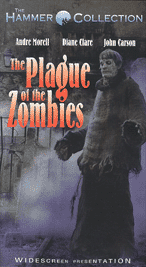 Sir James Forbes (Andre Morell) receives a fanatic letter from one of his prize pupil, a Dr. Peter Thompson (Brook Williams), telling of a strange virus that is ravishing the small countryside community where he practices. Upon arriving in Cornwall, Sir James and his lovely daughter Sylvia (Diane Clarke) are greeted by superstitious townsfolk and arrogant aristocrats. As they make their way through the crowd and over to the Thompson home, they are met at the door by Peters seemingly sick wife, Alice (Jacqueline Pearce), an old school chum of Sylvia. When Peter gets home he is both surprised and happy to find that his mentor has come to help him in his plight.
Unable to gain public support to perform an autopsy, Sir James and Peter decide that night to dig up a fresh corpse by the light of the full moon. At the same time back home, Sylvia witnesses Alice sneaking out to the moors and decides to follow her. In the graveyard, the two doctors are shocked to find the casket empty, while out on the moor Sylvia observes a corpse-like figure carrying the limp body of Alice.
Later the next day, Alice is found dead and an autopsy reveals that she isn’t suffer from rigor mortis and the blood in her body is no longer human. That night their worst fears are realized as Alice crawls out of her grave. A quick decapitation puts an end to that, but still the question remains as to who is behind these vile acts.
As James and Peter struggle to makes heads or tails from these bizarre events, the local Squire (John Carson) seems to have an unholy attraction to Sylvia. The plot continues to thicken when a quick survey reveals that the graves are empty and all trails lead to voodoo. But who is enslaving the undead???
Principal cinematography on The Plague of the Zombies began a mere week after Hammer had wrapped work on Rasputin The Mad Monk. Director John Gilling (The Gorgon, Trog) brought to life a moody atmospheric zombie-fest that relied more on storyline than gore. Special Effects master Roy Ashton prepared the zombie makeup, which harkens back to the days of White Zombie and no doubt was an influence on George Romeros Night of the Living Dead. This film proved to a huge success when it was double-billed with Dracula Prince of Darkness in both the UK and the US, but unfortunately for fans around the world, Hammer never did make a return visit to the land of the undead.
The Quatermass and the Pit Story
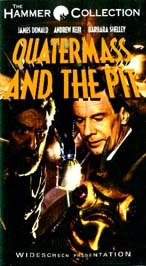 The story begins at the excavation sight of a London subway. The digging comes to an abrupt halt when workers unearth several prehistoric skulls and skeletal remains. Dr Roney (James Donald), an anthropologist and his assistant, Barbara Judd (Barbara Shelley) are called in to examine and study the unearthed remains. As excavating continues, what is thought to be a missile-like object is uncovered. Once this discovered, Colonel Breen (Julian Glover) and Professor Quatermass (Andrew Keir) are called in and they quickly determine the object is an unexploded bomb left over from the World War II.
As Professor Quatermass begins to look deeper into the origins of these remains he believes they are not of this Earth. Dr. Roney later informs Quatermass that he feels the skeletal remains are approximately five million years old, much older than any previous discovery. Further investigation into this specific neighborhood determines that for centuries it has been haunted by ghastly stories of beastly sightings, sounds, and strange occurrences
As Colonel Breen and his men completely unearth the “missile”, it’s discovered to be an alien craft, with a compartment inside that seems impenetrable to modern means to open it. The compartment suddenly opens and reveals occupants that appear to be large locust-like creatures. Quatermass, Roney, and Judd quickly remove the creatures and take them back to Roney’s lab for further study. What they discover in the lab will shake the very foundation of Earth’s history. What secrets do these insectoid creatures hold to the very existence of man on Earth? Where did these creatures come from and why did they travel to this planet?
Nigel Kneale’s excellent story and screenplay make for one of the best films from the Quatermass series. This film is atmospheric and thought-provoking and a much more pessimistic film than, “2001: A Space Odyssey“, a film released the same year as, “Quatermass and the Pit“. The direction of Roy Ward Baker keeps the film moving along at a wonderful pace and the overall atmosphere and acting only make this a film a must-see by sci-fi fans. Andrew Keir is perfectly cast in the role of Professor Quatermass, he combines the passion of the scientist with just the perfect touch of a man learning much more about his history than possibly wanted.
Julian Glover as Colonel Breen is a great antagonist to Quatermass, his unyielding views make his character much more interesting. James Donald and Barbara Shelley round out this top-notch cast with solid performances. “Quatermass and the Pit” or “Five Million Years To Earth” as it is also known as a fabulous combination of science fiction, horror and the occult. Hammer Studios did several science fiction films, but “Quatermass and the Pit” is one of the best and one film that all science fiction as well as Hammer fans should add to their list of “must-see” films. —HammerFanatic
The Devil Rides Out Story
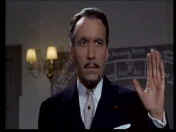 When Duc de Richeleau (Christopher Lee) and his friend Rex Van Ryn (Leon Greene) decide to pay a visit on their protg Simon Aaron (Patrick Mower), they find him hosting a meeting for a strange astronomical society. After a few minutes of mingling, a nervous Simon, guided by the bidding of his master, decides to show his good friends to the door, but Duc de Richelieu is susceptive and determined to investigate a hunch. Following a brief encounter with an unholy presence up in the observatory, the Duc realizes that this little get together is a front for a devil-worshipping sect led by the charismatic Mocata (Charles Gray). The two men barely escaped with an unconscious Simon and whisk back to the Duc’s home in a bid to save his mortal soul.
During the night, Simon is summoned by the power of Mocata to escape and rejoin him. The next day after some further research, the Duc believes that Simon, along with the beautiful Tanith (Nike Arrighi), is to be baptized into a satanic group better known as the Left-Hand Path. Fearing for their lives, Rex is dispatched to get some information as to when the initiation ceremony will be taking place. Later that night, as Mocata and his convent assemble in the woods to summon the Goat of Mendes (Aka. the Devil), Duc and Rex swoop in to rescue both Simon and Tanith from the clutches of this warlock, but their battle with the Dark Lord has only just begun.
Returning to the home of the Duc’s niece, the group begins to prepare for the evil that awaits them. A holy circle drawn around them helps repel the horrifying apparitions that manifest, but the slightest break in this protective ring will mean instant damnation for all, especially when the Angel of Death comes a calling. Who will win this classic battle between good and evil???
Based on the Dennis Wheatley’s bestseller “The Devil Rides Out”, this film directed by Hammer veteran and master of the macabre, Terence Fisher is easily one of the studio’s strongest entry in the horror genre. In the fall of 1963, Christopher Lee played a prominent role in convicting Hammer execs to acquire the rights to this story.
After several failed scripts by high-profile screenwriters, Richard Matheson (“Omega Man”, Legend of Hell House”, and “The Haunting”) was commissioned to breath new life into what many considered a very boring story. At the time, in part due to fears that the film’s release may be jeopardized because of content, Hammer felt it necessary to submit their shooting scripts to the BBFC for final approval.
The BBFC made it very clear that they would not put up with “any misuses of Christian emblems or any parodies of Christian prayers”. Finally, after many delays, the film went into production during the summer of 1967 and was later released in the summer of 1968.
“The Devil Rides Out” proved to be a landmark film for Christopher Lee because it confirmed the audience’s acceptance of him in the role of a hero, rather than a monster. Recent media quotes from the man himself have him citing his return to the role of Duc de Richelieu in a remake of this film. Exhibiting a superb storyline, exceptional acting especially by Lee and Charles Gray, and a wonderful score by James Bernard, “The Devil Rides Out is destined to be a prize in your horror collection.
The Satanic Rites of Dracula Story
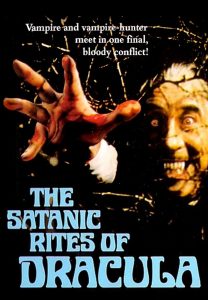 The story picks up two years after “Dracula AD 1972”. A strange cult with many of England top official as members has been reported and is under investigation. In the dying words of an undercover agent are tales of blood rituals and sacrifices. The authorities turn to Prof. Lorrimer Van Helsing (Peter Cushing), a distant relative of the original “Dr. Van Helsing”, for his knowledge of the “occult”. When he finds an old school chum is a member of this group, Van Helsing decides to questions him and learns about their plans to destroy the world with a new strain of the Bubonic Plague. But why????
As the plot lingers in spots, we discover that “Dracula” is behind this madness and this how he hopes to wreak his final revenge on mankind. But wouldn’t this lead to his death you may ask? Here Van Helsing surmises, “it is the only way to rid himself of this curse.” The ending is a little weak and nowhere nearly as effective as “Horror” or “Prince of Darkness”. At least we find out that a thorn bush is quite effective against the Lord of the Undead. I still recommend this film to all the fans based solely on Lee’s and Cushing’s performance.
This film marked the film pairing of Lee’s “Dracula” and Cushing’s “Van Helsing” battling it out on the silver screen. We should all consider ourselves blessed to have witnessed these two horror superstars sharing the spotlight with dignity and dedication to the genre. Horrors greatest arch-enemies. The year following the release of “The Exorcist“, “Satanism” was the in thing. So Hammer decided to team this new fade with the bread and butter of their success, “Dracula” in an attempt to save a dying studio. Unfortunately, they were not successful.
The Legend of the 7 Golden Vampires Story
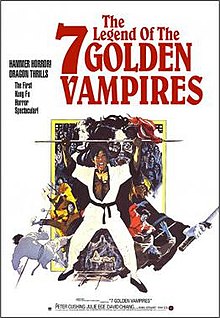 The story begins as a Buddhist monk (Chan Shen) is seen heading towards Dracula’s Castle. When he arrives he pleads with the Prince of Darkness to come back with him to save the seven golden vampires, but Dracula has other plans. So he assumes the identity of the monk and heads back to China.
At the same time, we find Dr. Van Helsing ( Peter Cushing) speaking to a group of students about the legend of a doomed village in China that becomes cursed every year at the time of the 7th moon. Van Helsing is later persuaded by Hsu Chinga (David Chiang) to join his family of kung fu experts and rid his village of the 7 golden vampires. Seven brothers and their one sister trained masters of the various arts battling the army of the undead. Pretty cool!!!!
Throw in a love story or two, one former Penthouse Pet, some kung fu, zombie fu, vampire fu and you have yourself one kick-ass movie. Although the fight scenes are not as crisp and precise as most Shaw Brother films, they still make for fun watching. Grab some popcorn, throw on your favorite gi, and prepare yourself for some immortal combat!!!!!!
This film melds two of my favorite pastimes, Horror, and Kung-Fu. Martial Art movies were at an all-time high back in 1974 and what better studio to the team- up with than the Shaw Brother of Hong Kong. You gotta love the trailer for this film “Black Belt meet Black Magic”. “Seven Brothers and their one sister meet Dracula”.
Just from that, two words come to mind and it’s not ” marketing genius”. This another film where Hammer was grasp to survive. This time we do see Peter Cushing as “Dr. Van Helsing“, but instead of Lee reprising his role of the “Count”, we see John Forbes-Robertson. Too bad. I would’ve loved to see Christopher Lee deliver a roundhouse kick to someones solar plexus.
Hammer Movies Fanspeak
DANNY R. FULCE
RE: PETER CUSHING
Hello. You have a really cool site & it’s been a pleasure to find another fan of “LEGEND OF THE 7 GOLDEN VAMPIRES” - this film has gotten a bad rap over the years for which it doesn’t deserve ! Hell, it’s far more exciting than HAMMER’s previous DRACULA films.
{ SATANIC RITES & SCARS OF.. come to mind} The thing to come out of HAMMER studio’s was PETER CUSHING ! For over 2 years now I’ve been a member of a great club devoted to the life & films of ST. PETER , it has been 2 of the best years of my life ! The club is non-profit { any money is given to the hospital that cared for MR. CUSHING in his final years} please write to BRIAN HOLLAND trelawney house, warbstow cross. warbstow. nr. launceston. Cornwall. PL15 8UP ENGLAND , tell him Danny sent you. THE PETER CUSHING ASSOCIATION - you will be happy you joined. You can also write to me…. 254 highland village mesquite tx. 75149 … please do!!!
Danny

Comments are closed.