

As a little boy, Tobe Hooper (the writer and director of TCM), while visiting relatives in Wisconsin, subconsciously suppressed the nightmarish tales of a reclusive farmer who was convicted for necrophilia, cannibalism, and murder. These stories of Ed Gein making masks from the skins of his victims and fashioning furniture from their bones filled this young boy’s imaginations.

| Full Name: | Edward Theodore Gein |
| Date of Birth: | August 27, 1906 |
| Birth Place: | Wisconsin |
| Death Date: | July 26, 1984 |
| Death Place: | Wisconsin |
| Job: | Serial Killer |
Hooper was forever scarred, and the foundation for LEATHERFACE was firmly etched in his mind, something he didn’t realize until after the fact. The purpose of this page is to provide information on Ed Gein, the ‘real’ American Psycho. Hooper was forever scarred, and the foundation for LEATHERFACE was firmly etched in his mind, something he didn’t realize until after the fact. The purpose of this page is to provide information on Ed Gein, the ‘real’ American Psycho. If you’re going to write an academic paper about this person, we advise you to contact writemyessay.today for professional help.
It is in “no way” to serve a tribute to this man or his ghastly deeds, but rather to recognize him as a source that forever shaped the way we watch horror today. He served as a model for many of the greatest villains to ever ravage across the silver screen: Norman Bates, LEATHERFACE, and the crazed killer, Buffalo Bill from “Silence of the Lambs”. He deeds went on to influence the storytelling of such films as “Maniac”, “Three on a Meathook”, and “Deranged”.
Movie Trailer
ED GEIN
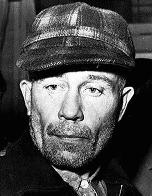 “I had a compulsion to do it.” Born at the turn of the century into the small farming community of Plainfield, Wisconsin, Gein lived a repressive and solitary life on his family homestead with a weak, ineffectual brother and domineering mother who taught him from an early age that sex was a sinful thing.
Eddie Gein ran the family’s 160-acre farm on the outskirts of Plain-field until his brother Henry died in 1944 and his mother in 1945. When she died her son was a thirty-nine-year-old bachelor, still emotionally enslaved to the woman who had tyrannised his life.The rest of the house, however, soon degenerated into a madman’s shambles. Thanks to federal subsidies, Gein no longer needed to farm his land, and he abandoned it to do odd jobs here and there for the Plainfield residents, to earn him a little extra cash.But he remained alone in the enormous farmhouse, haunted by the ghost of his overbearing mother, whose bedroom he kept locked and undisturbed, exactly as it had been when she was alive. He also sealed off the drawing room and five more upstairs rooms, living only in one downstairs room and the kitchen.
Ed Gein Post his Mother’s Death
“Weird old Eddie”, as the local community knows him, had begun to develop a deeply unhealthy interest in the intimate anatomy of the female body - and interest that was fed by medical encyclopedias, books on anatomy, pulp horror novels, and pornographic magazines. He became particularly interested in the atrocities committed by the Nazis during the Second World War and the medical experiments performed on Jews in the concentration camps.
Soon he graduated on to the real thing by digging up decaying female corpses by night in far-flung Wisconsin cemeteries. These he would dissect and keep some parts heads, sex organs, livers, hearts, and intestines. Then he would flay the skin from the body, draping it over a tailor’s dummy or even wearing it himself to dance and cavort around the homestead - a practice that apparently gave him intense gratification.
On other occasions, Gein took only the body parts that particularly interested him. He was especially fascinated by the excised female genitalia, which he would fondle and play with, sometimes stuffing them into a pair of women’s panties, which he would then wear around the house.
Not surprisingly, he quickly became a recluse in the community, discouraging any visitors from coming near his by now neglected and decaying farm.
Ed Gein’s Fascination
 Gein’s fascination with the female body eventually led him to seek out fresher samples. His victims, women of his mother’s age, included 54-year old Mary Hogan, who disappeared from the tavern she ran in December 1954, and Bernice Worden, a woman in her late fifties who ran the local hardware store, who disappeared on the 16th November 1957.Mrs. Worden’s son Frank was also the sheriff’s deputy, and upon learning that weird old Eddie Gein had been spotted in town on the day of his mother’s disappearance, Frank Worden and the sheriff went to check out the old Gein place, already infamous amongst the local children as a haunted house.
Gein’s bizarre obsessions
There, the gruesome evidence proved that Gein’s bizarre obsessions had finally exploded into murder, and much, much worse. In the woodshed of the farm was the naked, headless body of Bernice Worden, hanging upside down from a meat hook and slit opens down the front. Her head and intestines were discovered in a box and her heart on a plate in the dining room.
The skins from ten human heads were found preserved, and another skin taken from the upper torso of a woman was rolled up on the floor. There was a belt fashioned from carved-off nipples, a chair upholstered in human skin, the crown of a skull used as a soup-bowl, lampshades covered in flesh-pilled taut, a table propped up by a human shinbone, and a refrigerator full of human organs.
The four posts on Gein’s bed were topped with skulls and a human head hung on the wall alongside nine death masks - the skinned faces of women - and decorative bracelets made out of human skin. The stunned searchers also uncovered soup bowls fashioned from skulls, a shoebox full of female genitalia, faces stuffed with newspapers and mounted like hunting trophies on the walls, and a “mammary vest” flayed from the torso of a woman. Gein later confessed that he enjoyed dressing in this and other human-skin garments and pretending he was his own mother.
The Ed Gein House
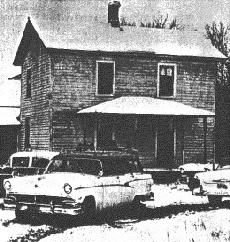
The scattered remains of an estimated fifteen bodies were found at the Ed Gein farmhouse when Gein was eventually arrested, but he could not remember how many murders he had actually committed. The discovery of these Gothic horrors sent shock waves throughout Eisenhower-era America.In Wisconsin itself, Ed Gein quickly entered local folklore. Within weeks of his arrest, macabre Jokes called “Geiners” became a statewide craze. The country as a whole learned about Ed Gein in December 1957, when both Life and Time magazines ran features on his “house of horrors.”
Ed Gein Death
After ten years in a mental hospital, Ed Gein was judged competent to stand trial. Although considered fit to stand trial, Eddie was found guilty, but criminally insane. He was first committed to the Central State Hospital at Waupon, and then in 1978, he was moved to the Mendota Mental Health Institute where he died in the geriatric ward in 1984, aged seventy-seven.It is said he was always a model prisoner - gentle, polite and discreet. He died of respiratory and heart failure in 1984.
By then, however, Ed Gein had already achieved pop immortality, thanks to horror writer Robert Bloch, who had the inspired idea of creating a fictional character based on Gein-a deranged mama’s boy named Norman Bates.
In 1960, Alfred Hitchcock transformed Bloch’s pulp chiller, “Psycho”, into a cinematic masterpiece. Insofar as “Psycho” initiated the craze for “slasher” movies, Gein is revered by horror buffs as the prototype of every knife-, axe-, and cleaver-wielding maniac who has stalked America’s movie screens for the past thirty years.
Gein Similarities in Movies
There are some obvious similarities between Hitchcock’s reclusive Norman Bates and the apparently inoffensive but secretly deranged, mother-fixated Gein.
Hitchcock’s “Psycho” led on, of course, to a plethora of pale imitators: “Psycho 2”, written by Tom Holland and directed by Richard Franklin, “Psycho III” (1986), written by Charles Edward Pogue and directed by Anthony Perkins, and Mick Garris’s “Psycho IV: The Beginning” (1990), which was made for cable TV, and went straight to video in Europe.
The Ed Gein case also provided a basis for the 1967 monster movie “It”, ostensibly based on the mythical Jewish folk demon, the Golem, in which mad curator Roddy McDowall carries on conversations with the rotten corpse of his mother, which he keeps at home in her bed.Ed Gein Comparison with The Texas Chain Saw Massacre What happened is true! Now the movie that’s just as real!”, screamed the posters for Tobe Hooper’s 1974 classic of independent cinema.
Whilst not a literal rendition of the Ed Gein case, the terrible house in Chain Saw, with its bizarre artifacts made out of human detritus - armchairs that bear human arms, lamps made out of human hands - resembles the Ed Gein homestead in many of its particulars, and the crazy Leatherface, who hangs up his victims alive on meat hooks, also sports a grotesque mask fashioned from stitched together pieces of human skin.
Movies inspired by Ed Gein Story
In Joseph Ellison’s 1980 study of psychopathic child abuse “Don’t Go In The House”, Donny (Dan Grimaldi) keeps the corpse of his religious fanatic mother in his apartment, and, as a consequence of her nasty habit of burning his arms when he misbehaved as a child, enjoys nothing better than bringing a young woman home and frying her up alive.
In William Lustig’s “Maniac” (1980), the eponymous Oedipal killer indulges in garroting, deception, shooting, and scalping, with the murderer’s scalp collection adorning a row of tailor’s mannequins.
Ed Gein’s fondness for wearing human flesh resurfaced again in 1991 as one inspiration for the character Buffalo Bill in Jonathan Demme’s “Silence of the Lambs”, the homosexual psycho killer so named because he liked to “skin his humps”.
Ed Gein was also the inspiration for the psycho-biopic “Deranged”, a 1974 offering from American-International Pictures, co-written and co-directed by Alan Ormsby.
And the lesser-known but equally reverential “Three On A Meathook” (1973), directed by small-time auteur William Girdler and filmed in Louisville, Kentucky.
It also seems likely that Jorg Buttgereit, a self-confessed “Geinophile”, was influenced by Eddie’s predilections whilst making his paeans to necrophilia, “Nekromantik” (1988) and “Nekromantik 2” (1991).
This bio is a combination of articles that appear in the following reference sources
“The US history”, by official USA and “Murder is Meat: An Illustrated Guide to Cannibal Culture”, by Mikita Brottman
Ed Gein Movies
- Three On A Meathook - (1973)
- Deranged - 1974
- Maniac (1980)
- Don’t Go In The House - 1980
- Geinophile - 1988
- Nekromantik 2 (1991)
- Silence of the Lambs - 1991
Ed Gein Quotes
- “When I see a pretty girl walking down the street, I think two things. One part wants to be real nice and sweet, and the other part wonders what her head would look like on a stick” — Ed Gein.
- “She isn’t missing. She’s at the farm right now.” — Ed Gein. …
- “I had a compulsion to do it.” — Ed Gein.
Also, Read